

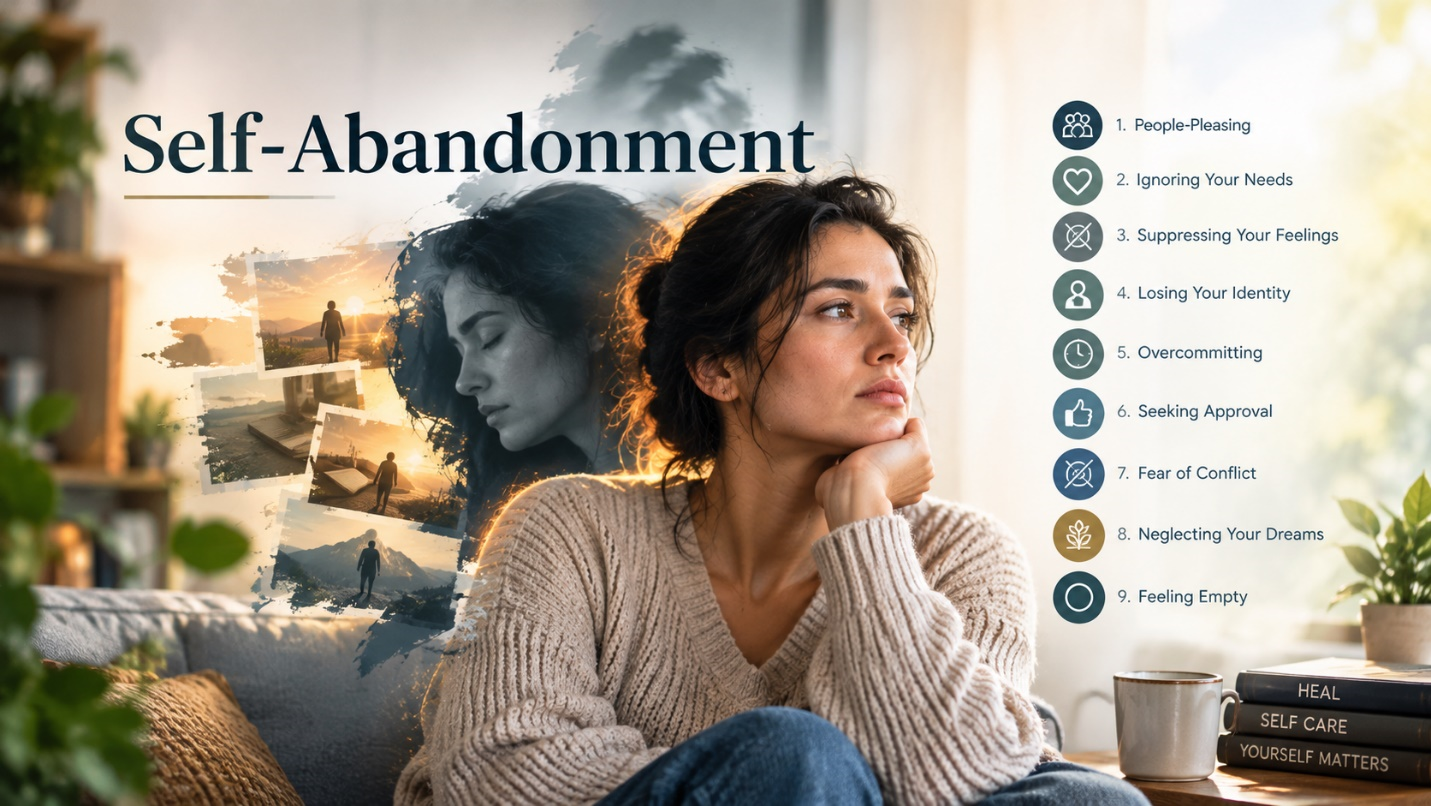
Maybe you rarely argue.
You say “it’s fine” when something hurts. You agree to plans you do not want. You apologize quickly so tension disappears. You become the flexible one, the understanding one, the person who asks for very little.
From the outside, that can look like kindness.
Inside, though, you may feel tired, resentful, disconnected, or unsure what you actually want anymore.
Those can be self-abandonment signs.
In this article, self-abandonment describes a pattern of repeatedly ignoring your needs, feelings, limits, values, or inner judgment in order to preserve approval, connection, or peace. It is not about occasional compromise. Healthy relationships require compromise. The problem begins when keeping other people comfortable repeatedly requires you to disappear.
For Geraldo Pagan, LMHC, themes such as emotional awareness, trauma recovery, family relationships, identity, and self-discovery sit at the center of both his counseling background and his writing. That makes self-abandonment an important topic because recognizing yourself again often begins with noticing where you stopped listening to yourself.
Key Takeaways
- Self-abandonment often looks like people-pleasing, conflict avoidance, weak boundaries, self-doubt, and ignoring your own needs.
- Compromise is chosen. Self-abandonment often feels driven by fear, guilt, rejection, or pressure.
- Resentment can be a clue that you have been saying yes when part of you wanted to say no.
- Recovery starts with awareness, small honest choices, and learning to trust your own feelings and limits again.
What Does Self-Abandonment Mean?
Self-abandonment happens when you repeatedly move away from what you know, feel, need, or value because another person’s approval or comfort feels more urgent.
It might sound like:
“I don’t want to upset them.”
“They’ll think I’m selfish.”
“It’s easier if I just agree.”
“I can handle it.”
“My needs aren’t that important.”
“I don’t want this to become an argument.”
The behavior may keep a moment calm, but the cost can show up later as resentment, emotional exhaustion, confusion, or feeling unseen.
This overlaps closely with people-pleasing. A 2025 peer-reviewed study found that stronger people-pleasing tendencies were significantly associated with lower mental well-being. The researchers described people-pleasing as prioritizing other people’s desires while sometimes remaining silent about one’s own needs.
There is also a wider cultural issue around guilt and self-care. In a 2025 American Psychological Association/Harris Poll, 21% of U.S. adults said they felt guilty taking time for themselves.
Caring about other people is not the problem.
The question is whether you are included in that care.
Is Self-Abandonment the Same as Healthy Compromise?
No.
Compromise asks both people to matter. Self-abandonment regularly removes one person from the equation: you.
| Healthy Compromise | Self-Abandonment |
| You know what you want before choosing | You may not check what you want |
| You choose freely | You act mainly from fear or guilt |
| Both people adjust at times | You are usually the one adjusting |
| You can disagree safely | Disagreement feels dangerous |
| Your values remain intact | You may act against your values |
| You can say no when necessary | Saying no feels almost impossible |
| The relationship still feels mutual | Resentment quietly grows |
A useful question is:
“Would I still make this choice if I knew the other person would not be angry, disappointed, or likely to leave?”
Your answer can tell you a lot.
9 Self Abandonment Signs You May Be Missing
1. You Say Yes Before Checking Whether You Want To
Someone asks for a favor.
Your answer comes out immediately:
“Of course.”
Then five minutes later, you feel irritated.
This is one of the clearest self abandonment signs because you skipped the most basic question:
Do I actually want to do this?
People who have spent years keeping others happy may become so quick to respond that they do not notice their own answer until after they have committed.
You may agree to:
- Extra Work
- Social Plans
- Family Responsibilities
- Lending Money
- Emotional Support
- Changing Your Schedule
- Doing Favors When You Are Exhausted
The problem is not generosity.
Generosity becomes costly when you no longer experience yourself as having a real choice.
Try this instead
Replace the automatic yes with:
“Let me check and get back to you.”
That one sentence creates space between the request and your decision.
2. You Second-Guess Your Own Decisions
You know what you want.
Then someone disagrees.
Suddenly, you are no longer sure.
Maybe you change the restaurant, career plan, outfit, parenting decision, relationship boundary, or personal goal because another person sounds more certain than you feel.
Repeated self-doubt can slowly teach you that other people’s opinions carry more authority than your own experience.
This does not mean ignoring good advice.
Healthy decision-making includes listening to people you trust.
The difference is whether their input helps you think or replaces your ability to think for yourself.
Ask yourself
“What did I believe before someone else told me what I should believe?”
Sometimes your first answer deserves another look.
3. You Keep the Peace by Hiding What You Really Feel
Conflict avoidance can feel safe.
You smile.
You say “no worries.”
You tell everyone you are okay.
Meanwhile, you are hurt, frustrated, disappointed, or angry.
Keeping every disagreement quiet can look peaceful, but silence is not always peace.
Sometimes it is fear.
You might worry that honesty will make someone:
- ANGRY
- DISTANT
- DISAPPOINTED
- CRITICAL
- DEFENSIVE
- LESS INTERESTED IN YOU
So instead of dealing with the discomfort of disagreement, you absorb it.
That can work briefly.
Over time, the feelings usually go somewhere.
Often, they become resentment.
4. You Change Yourself Depending on Who You Are With
Different relationships naturally bring out different sides of us.
Self-abandonment goes further.
You may begin changing your opinions, interests, personality, preferences, appearance, or values depending on who is around.
Maybe your partner loves something, so suddenly you love it too.
A friend dislikes something you care about, so you stop talking about it.
Someone strongly disagrees with your opinion, so you quietly reverse it.
This pattern can help you feel accepted while gradually making your identity harder to recognize.
The relationship stays.
You become less visible inside it.
That is one reason this pattern connects so closely with the themes of authenticity and self-discovery explored in Navegando al Alma. The book asks readers to look inward at fears, beliefs, wounds, silences, and the parts of themselves that may have been pushed aside.
5. You Ignore Your Needs Until You Are Exhausted
You know you are tired.
You keep going.
You need quiet.
You answer another call.
You need help.
You tell everyone you are fine.
You need rest.
You feel guilty taking it.
Self-abandonment is not always dramatic. Sometimes it looks like repeatedly putting your basic emotional and physical needs at the bottom of the list.
Social worker Karen Salerno explains in Cleveland Clinic’s 2026 guidance that healthy boundaries begin with knowing what you need and protecting your time, energy, and emotional well-being.
Ignoring yourself does not make you more caring.
It simply means care is moving in only one direction.
6. Your Inner Voice Is Much Harsher Than Your Voice With Other People
Someone you love makes a mistake.
You respond with compassion.
You make the same mistake.
Your mind says:
“You’re stupid.”
“What is wrong with you?”
“You always ruin everything.”
“Everyone else handles this better.”
Self-abandonment can happen internally too.
When you repeatedly dismiss your feelings, insult yourself, or treat your needs as weaknesses, you become the person who invalidates you.
Notice whether your inner voice sounds more like guidance or punishment.
You do not need to approve of every choice you make.
You can correct yourself without attacking yourself.
7. You Believe Being “Easy” Makes You Easier to Love
Low maintenance.
Flexible.
Never difficult.
Never needy.
Always understanding.
These traits can sound attractive, but they become painful when they are built on the belief that you must require very little in order to keep people close.
Maybe you avoid asking for:
- REASSURANCE
- RESPECT
- TIME
- EMOTIONAL SUPPORT
- CONSISTENCY
- AFFECTION
- ACCOUNTABILITY
- HELP
because asking feels risky.
The hidden rule becomes:
If I need less, people are less likely to leave.
But a relationship in which you must hide yourself to preserve connection cannot fully know you.
8. You Build Resentment but Rarely Speak Up
Resentment is often treated like proof that someone else has done something wrong.
Sometimes it is.
Other times, resentment is also information about what you repeatedly agreed to despite not wanting it.
Maybe you keep doing favors.
Keep accepting behavior that hurts.
Keep giving more time.
Keep saying everything is okay.
Then another small request feels unbearable.
The other person may be confused because they never heard the earlier no that stayed inside you.
Do this, not that
Do this: “I can’t take that on this week.”
Not that: Say yes, feel angry about it, then expect the other person to realize what you needed.
Speaking earlier may prevent a much larger emotional reaction later.
9. You Go Against Your Values to Keep Approval or Connection
This is one of the deeper forms of self-abandonment.
You may know something does not feel right, yet agree because saying no could cost you approval.
You might:
- stay silent when something violates your values
- tolerate behavior you once said you would not accept
- lie about your preferences
- betray a personal boundary
- remain in situations that repeatedly harm your emotional well-being
- dismiss your intuition because someone else disagrees
Compromise asks:
“What can I willingly give here?”
Self-betrayal asks:
“How much of myself do I have to give up so this person will stay?”
Those are not the same question.
Why Do People Abandon Themselves to Keep the Peace?
There is rarely one explanation.
For some people, the pattern may have developed in families where conflict felt unpredictable.
You may have learned that being quiet, helpful, agreeable, high-performing, or emotionally easy reduced tension.
Other people develop similar habits because of rejection fears, low self-worth, difficult relationships, cultural expectations, family roles, or past experiences in which expressing needs did not feel safe.
Your supplied source material describes this pattern clearly: focusing heavily on other people can become a learned way of preserving connection, particularly when making demands or expressing needs once felt risky.
That does not mean everyone who people-pleases experienced trauma.
It means patterns usually have a history.
Understanding the history can help you stop treating the behavior as a character flaw.
Why Can Self-Abandonment Feel Like Love?
Because connection matters.
If agreeing keeps someone close, your mind may interpret the agreement as successful.
You avoided an argument.
They are happy.
The relationship continues.
Everything seems fine.
But ask what the relationship is staying connected to.
If you continually hide your needs, opinions, hurt, preferences, and identity, the other person may remain close to a version of you that feels safer to present.
That can create closeness without full honesty.
The source material describes three useful patterns:
The Chameleon
You adapt yourself to match the person you want to keep.
The Peacekeeper
You avoid expressing anything that might create disagreement.
The Silent Resenter
You act agreeable while privately keeping track of everything you have given up.
These are useful descriptions, not diagnoses.
They can simply help you notice where your own pattern may be showing up.
What Most People Get Wrong About Boundaries
People sometimes hear “set boundaries” and assume the solution is to become rigid, distant, or confrontational.
That is not the goal.
Healthy boundaries tell people what you can and cannot participate in.
They do not control someone else.
Cleveland Clinic’s 2026 guidance puts it clearly: healthy boundaries communicate your needs while still recognizing the needs of the people around you.
A boundary is not:
“You are not allowed to get angry with me.”
You cannot control that.
A boundary can be:
“If the conversation becomes insulting, I’m going to step away and return when we can talk respectfully.”
The second statement focuses on what you will do.
That is the difference.
The Honest Choice Test
When you are unsure whether you are compromising or abandoning yourself, ask three questions:
1. Is this choice honest?
Do I actually mean yes?
2. Is this choice free?
Would I still choose it without fear, guilt, pressure, or the threat of rejection?
3. Is this choice sustainable?
Can I keep doing this without becoming exhausted, resentful, or disconnected from myself?
One uncomfortable yes does not automatically mean self-abandonment.
Look for the pattern.
How Do You Stop Self-Abandoning Yourself?
Change usually starts smaller than people expect.
You do not have to rebuild every boundary this week.
You do not need to confront every person in your life.
Start by becoming easier to hear inside your own mind.
Step 1: Pause Before Answering
Someone asks for something.
Do not answer instantly.
Give yourself a few seconds.
For text messages, put the phone down before replying.
That small pause interrupts automatic agreement.
Step 2: Name What You Actually Feel
Ask yourself:
“What am I feeling?”
“What do I want?”
“What do I need?”
“What feels wrong here?”
You cannot speak for yourself clearly if you never check in with yourself first.
Step 3: Practice Small Honest Answers
Start somewhere low-risk.
“I’d rather eat somewhere else tonight.”
“I’m tired, so I’m going home.”
“I can’t help this weekend.”
“I need some time to think.”
Small acts of honesty build self-trust.
Step 4: Let Someone Be Disappointed
This can be the hardest step.
Another person’s disappointment does not automatically mean your decision was wrong.
Sometimes healthy boundaries disappoint people who preferred having unlimited access to your time or energy.
That discomfort can pass.
Step 5: Notice What Happens to Resentment
Pay attention over the next few weeks.
Does resentment decrease when you become clearer sooner?
That can be a useful signal that your relationships are becoming more honest.
What Does Rebuilding Self-Trust Look Like?
Self-trust grows when your actions start matching your inner experience.
You notice exhaustion and rest.
You dislike something and admit it.
You need time and ask for it.
You say no and survive the discomfort.
You make a decision and resist asking five people whether it was correct.
You make a mistake without turning against yourself.
Gradually, your internal voice becomes more familiar.
For people interested in exploring identity, emotional pain, self-reflection, and the parts of life we sometimes keep silent, Navegando al Alma is especially relevant.
For families and younger people working through overwhelming emotions, trauma, fear, shame, anger, and identity, Navegando la Tormenta Interior offers another path into those conversations. The themes of both books closely match Geraldo Pagan’s broader work in emotional wellness and self-discovery.
When Can Therapy Help With Self-Abandonment Patterns?
Therapy may be useful when you understand the pattern intellectually but still feel unable to change it in real relationships.
You may know you need boundaries yet panic when someone becomes upset.
You may know you are allowed to say no yet experience intense guilt afterward.
You may understand that a relationship is one-sided yet still feel responsible for keeping it together.
Working with a mental-health professional can give you room to look at:
- Relationship Patterns
- Family Roles
- Fear Of Rejection
- Trauma History
- Self-Worth
- Anxiety
- Anger And Resentment
- Identity
- Communication
- Boundary Setting
- Emotional Regulation
- Decision-Making
Geraldo Pagan’s professional background includes more than two decades of work with children, adolescents, adults, and families facing trauma, family conflict, anxiety, grief, behavioral concerns, and emotional crises. His practice background also includes individual therapy, family therapy, and trauma treatment.
An Illustrative Example
Suppose someone asks you to attend a family gathering on your only free evening.
You are exhausted.
Your first thought is:
“I really need to stay home.”
Your second thought is:
“If I don’t go, everyone will think I’m selfish.”
You immediately say yes.
At the gathering, you feel irritated by everyone.
Later, you wonder why you are so resentful.
The invitation was not necessarily the problem.
The missing step happened before your answer.
You never gave yourself permission to consider your own capacity.
A different response might be:
“Thanks for inviting me. I’m exhausted tonight, so I’m going to sit this one out.”
Someone might still be disappointed.
But this time, you did not disappear to prevent that disappointment.
Final Thoughts
Recognizing self abandonment signs is not about becoming more self-centered.
It is about noticing whether your relationships leave room for you to exist honestly inside them.
Compromise matters.
Kindness matters.
Generosity matters.
So do your needs, your limits, your values, and your voice.
Start small. Pause before answering. Notice resentment. Check whether your yes is honest. Let yourself have preferences. Say what hurt before it turns into months of silence.
Keeping the peace should not require losing yourself.
If these patterns feel deeply rooted in family history, trauma, anxiety, or relationship conflict, learning more about Geraldo Pagan’s mental-health and emotional-wellness work can be a helpful next step.
Frequently Asked Questions
What are common self abandonment signs?
Common self abandonment signs include saying yes when you want to say no, ignoring your needs, second-guessing decisions, avoiding conflict, changing yourself for other people, harsh self-criticism, weak boundaries, resentment, and acting against your values to gain approval.
What causes self-abandonment?
Self-abandonment can develop for many reasons. Some people learn early that keeping others happy reduces conflict or helps them maintain connection. Fear of rejection, low self-worth, family patterns, anxiety, trauma, and past relationship experiences may also contribute.
Is self-abandonment the same as people-pleasing?
They overlap, but self-abandonment is a broader descriptive idea. People-pleasing often involves trying to keep others happy. Self-abandonment may also include ignoring feelings, doubting your judgment, neglecting your needs, hiding parts of your identity, or acting against your values.
How do I know whether I am compromising or abandoning myself?
Look at choice, fear, and repetition. Healthy compromise is usually voluntary and mutual. Self-abandonment tends to become a repeated pattern in which fear, guilt, or rejection concerns cause you to keep giving up needs, limits, or values.
Why do I feel guilty when I set boundaries?
Guilt can appear when boundary setting is unfamiliar or when you learned that meeting your own needs disappoints other people. Feeling guilty does not automatically mean the boundary is wrong. New behavior often feels uncomfortable before it feels normal.
Can self-abandonment cause resentment?
Repeatedly ignoring your needs can contribute to resentment, especially when you keep agreeing to things you do not want. Speaking honestly earlier can sometimes prevent years of unspoken frustration from building inside a relationship.
Can you stop people-pleasing without becoming selfish?
Yes. Caring for yourself and caring for others are not opposites. Healthy relationships leave room for both people’s needs, limits, preferences, and feelings. Setting a respectful boundary does not require becoming uncaring or hostile.
When should I talk to a therapist about self-abandonment?
Consider professional support when the pattern feels difficult to change, causes significant distress, repeatedly harms relationships, or seems tied to trauma, anxiety, fear of rejection, family conflict, low self-worth, or difficulty knowing who you are outside other people’s expectations.
How can therapy help with boundaries and self-trust?
Therapy can provide space to examine where the pattern came from, notice emotional triggers, practice clearer communication, build self-trust, explore family and relationship patterns, and learn to express needs without automatically treating conflict or disappointment as danger.