

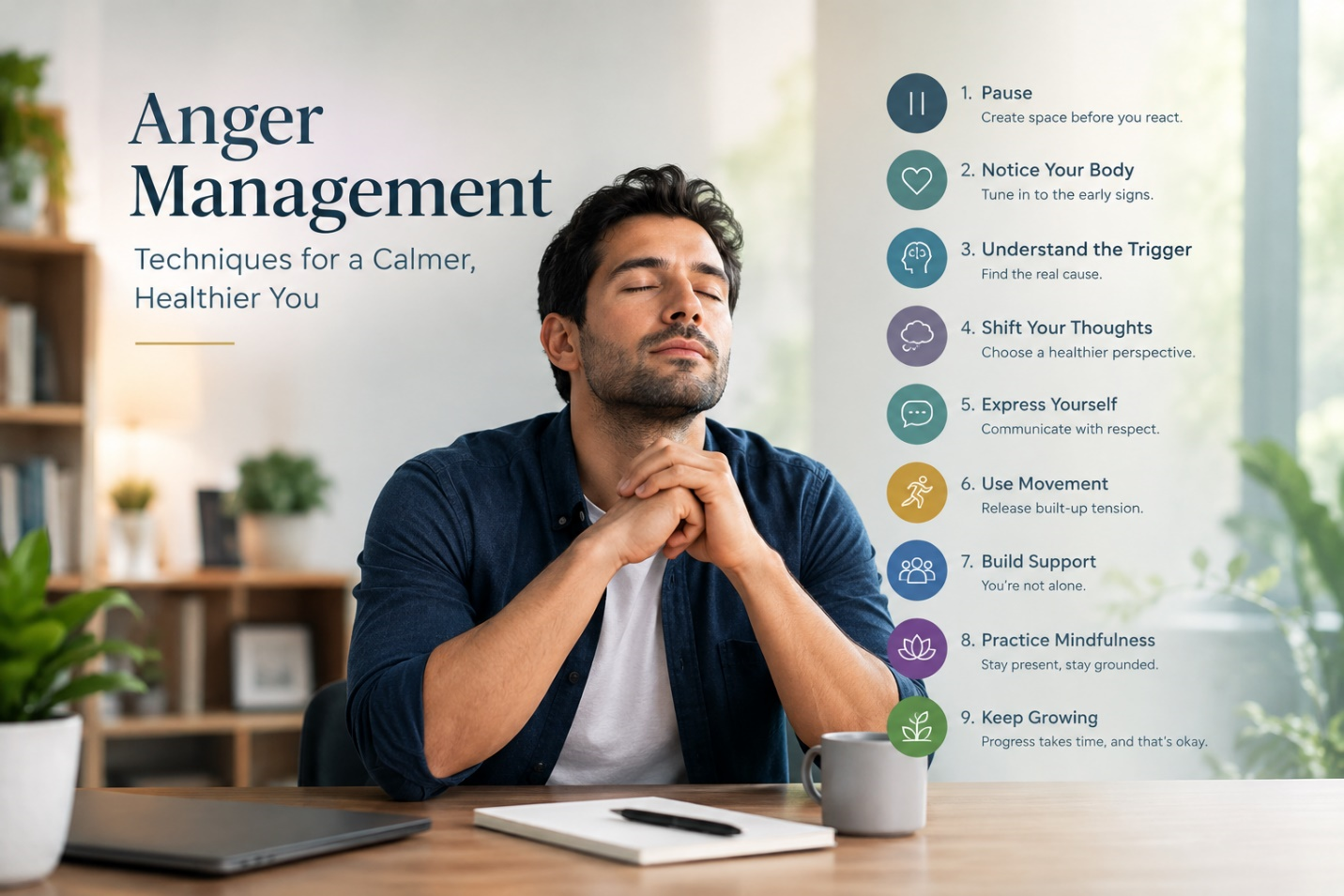
You feel your chest tighten. Your voice changes. Maybe your jaw clenches, your thoughts speed up, or you suddenly want to say the one thing you know will make the argument worse.
That moment matters.
Using the right anger management techniques does not mean pretending you are not angry. It means learning to notice what is happening early enough to choose your response instead of letting the emotion choose it for you.
Anger itself is not the enemy. The American Psychological Association describes anger as an emotional state that can range from mild irritation to intense rage. Problems begin when anger repeatedly leads to aggression, damaged relationships, regretted words, or behavior that feels difficult to control. American Psychological Association: Anger
Through his work in emotional wellness and mental-health education, Geraldo Pagan emphasizes understanding what lies beneath difficult reactions. That matters with anger because the reaction you see on the surface may be connected to stress, disappointment, fear, hurt, frustration, or a sense of being ignored.
Key Takeaways
- Anger is a normal emotion. The goal is to manage your response, not eliminate the feeling.
- The earlier you notice physical and mental warning signs, the easier it becomes to interrupt an automatic reaction.
- Breathing, taking space, cognitive reframing, movement, and assertive communication can all help with anger control.
- Repeated anger that harms relationships, work, safety, or daily life may need support from a licensed mental-health professional.
What Does Anger Management Actually Mean?
Anger management means recognizing what triggers anger, noticing how it builds in your body and thoughts, and learning skills that help you respond without becoming aggressive or destructive. It is not about never becoming angry. It is about gaining more choice over what happens next.
That difference is important.
Trying to suppress every angry feeling can leave the real problem untouched. Exploding whenever you feel angry can damage trust and make conflict harder to resolve.
Healthy anger management sits between those two extremes.
Recent research also supports the close relationship between anger and emotion regulation. A 2025 meta-analysis published in Scientific Reports examined how different emotion-regulation strategies relate to anger and noted that difficulties with emotional regulation have played a central role in cognitive-behavioral approaches to anger problems. Read the 2025 Scientific Reports meta-analysis
Anger, aggression, and assertiveness are not the same thing
| Response | What It May Look Like | Likely Result |
| Suppression | Staying silent while resentment builds | Tension may remain unresolved |
| Aggression | Shouting, insulting, threatening, or trying to control | Conflict often becomes worse |
| Assertiveness | Naming the problem clearly and respectfully | Creates more room for discussion and problem-solving |
Feeling angry does not require acting aggressively.
Learning to separate the emotion from the behavior is one of the most useful shifts you can make.
Why Can Anger Feel So Hard to Control in the Moment?
Strong anger affects both your thinking and your body.
Your breathing may become quicker. Muscles can tighten. Your heart may beat faster. Your attention may narrow toward whatever feels unfair, threatening, insulting, or frustrating.
Thinking can become more absolute too.
Words such as “always,” “never,” “everyone,” and “nothing” can suddenly feel accurate even when they are not.
That combination makes reacting quickly tempting.
The goal of anger control is to create enough space between the trigger and the response for clearer thinking to return.
Gallup’s 2026 global workplace data found that 22% of employees worldwide reported experiencing anger during much of the previous day in 2025. Anger is clearly not an unusual human experience. What matters is what we learn to do with it.
Use the PAUSE Rule Before You React
When anger rises quickly, remembering nine different strategies can be difficult. Use this five-part rule first:
P: Pause
Do not answer immediately if you know your reaction is escalating.
A: Attend to your body
Notice your breathing, heartbeat, jaw, shoulders, hands, and voice.
U: Understand the trigger
Ask what happened and what meaning you gave it.
S: Shift the thought
Replace extreme assumptions with a more accurate description.
E: Express yourself deliberately
Speak after you can communicate the problem without attacking the person.
The PAUSE rule does not solve every conflict. It gives you enough room to choose which anger management technique fits the situation.
9 Anger Management Techniques to Regain Control
1. Learn Your Early Warning Signs
Most angry reactions do not appear from nowhere.
Your body often signals the change before your words or behavior do.
You may notice:
- clenched teeth
- tight shoulders
- heat in your face
- faster breathing
- restless movement
- raised voice
- pressure in your chest
- racing thoughts
- an urge to interrupt
- repeated thoughts about disrespect or unfairness
Treat these signals like an early warning system.
Catching anger at a four out of ten gives you more options than noticing it after it reaches a nine.
Try this
For one week, write down three things after a strong anger episode:
- What happened?
- What did you notice in your body?
- What thought appeared right before your anger increased?
Patterns often become easier to see once you stop treating each incident as completely separate.
2. Take a Real Pause Before You Speak
Silence for a few moments can prevent a conversation from becoming something much harder to repair.
Pausing does not mean refusing to deal with the issue.
It means delaying the discussion until you can participate more clearly.
You might say:
“I want to talk about this, but I need a few minutes before I respond.”
That is different from storming away without explanation.
When possible, agree to return to the conversation. A useful timeout creates space. It should not become punishment or avoidance.
Do this, not that
Do this: Step away with a clear plan to return.
Not that: Leave in anger, send hostile messages, or continue the argument from another room.
3. Slow Your Breathing and Relax Your Body
Your thoughts are only one part of anger. Your body is involved too.
Slow breathing can help you interrupt some of the physical intensity.
Try breathing lower into your abdomen instead of taking quick breaths high in your chest.
Relax your shoulders.
Unclench your hands.
Release your jaw.
Give your body a few minutes to settle before trying to solve the disagreement.
Relaxation becomes more useful when you practice it during calm moments too. Waiting until you are already overwhelmed makes every skill harder to use.
4. Challenge the Thought Fueling the Anger
This is where cognitive reframing can help.
The event itself may be frustrating, but the story you immediately tell yourself about the event can increase the intensity.
Consider the difference:
“They never respect me.”
versus:
“I felt dismissed by what happened, and I want to address it.”
The second statement does not excuse the problem. It describes it more accurately.
Watch for thinking patterns such as:
- “They always do this.”
- “Nobody cares what I need.”
- “This ruined everything.”
- “They did it just to make me angry.”
- “This should never happen.”
Replace certainty with curiosity.
Ask:
“What do I actually know?”
“What am I assuming?”
“Is there another possible explanation?”
“What response would help me deal with the problem rather than add another one?”
This kind of thought work closely reflects cognitive behavioral therapy principles.
5. Separate the Problem From What You Cannot Control
Some anger comes from real problems.
The answer is not always positive thinking.
Maybe someone repeatedly crosses a boundary. Maybe work pressure is unreasonable. Maybe a family disagreement has gone unresolved for months.
Identify what part of the situation you can act on.
Then identify what you cannot control.
You can request a change.
You can set a boundary.
You can leave an unhealthy conversation.
You can adjust your schedule.
You can decide how you will respond.
You cannot control another person’s thoughts, mood, choices, or willingness to agree with you.
Putting your effort into the part you can influence often reduces the feeling of fighting against everything at once.
6. Use Assertive Communication Instead of Attack
Once you are calmer, say what actually needs to be said.
Try describing:
- what happened
- how it affected you
- what you need
- what you would like to happen next
For example:
“You never listen to me” attacks the other person’s character.
“I felt ignored when I was interrupted several times. I would like to finish what I am saying before we respond to each other” gives the conversation something specific to work with.
Listening matters too.
Sometimes the words that trigger us are covering another concern underneath. A partner may sound critical when they are actually feeling disconnected. Someone at work may sound defensive because they think they are being blamed.
Listening does not mean agreeing. It means trying to understand before deciding how to respond.
7. Move the Physical Tension Somewhere Safer
Stress and physical tension can lower your patience.
Movement gives that tension somewhere safer to go.
Walking, exercising, stretching, or another form of physical activity may help you reset before returning to a difficult conversation.
The goal is not to rehearse the argument while you exercise.
Use the movement to create distance from the immediate reaction.
Then come back to the issue with a clearer head.
8. Change the Timing or Environment
Sometimes the smartest anger management technique is surprisingly practical.
Do important conversations always become arguments late at night?
Choose another time.
Does a particular environment leave you overstimulated before you even begin talking?
Move somewhere quieter.
Does your commute regularly leave you furious before you arrive home?
Consider whether changing your route, timing, or transition routine is realistic.
Reducing predictable triggers is not weakness. It is planning.
You do not have to repeatedly place yourself in the exact conditions where you know your reactions become harder to manage.
9. Review What Happened After the Anger Passes
Improvement happens after the moment too.
Once you are calm, ask:
- What triggered me?
- What feeling was underneath my anger?
- When did I first notice my body changing?
- Which thought made the situation worse?
- What did I do that helped?
- What do I want to do differently next time?
- Do I owe someone a repair or apology?
Reflection turns a difficult moment into information.
For readers who want to think more deeply about emotional reactions, fear, hurt, identity, and the stories beneath outward behavior, Navegando la Tormenta Interior explores those themes through a human and family-centered lens.
Readers interested in inner awareness, emotional wounds, beliefs, reflection, and the connection between mind and personal experience can also explore Navegando al Alma.
What Most People Get Wrong About Anger
One of the most persistent myths is that anger needs to be “released” through aggressive venting.
That can feel satisfying for a few seconds, but feeling relief is not the same as solving the problem.
The American Psychological Association warns that freely “letting it rip” can increase anger and aggression rather than resolve the situation.
Another common mistake is treating anger as proof.
Feeling certain that someone disrespected you does not automatically mean you know their intention.
Strong emotion gives information about your experience. It does not always give complete information about the other person’s motives.
Better rule
Feel the emotion. Check the story. Choose the behavior.
All three steps matter.
What Can This Look Like in Real Life?
Consider this illustrative example.
You come home tired after a stressful day. Someone close to you makes a comment that sounds critical.
Your first thought is:
“They have no idea what I deal with. They are always criticizing me.”
Your shoulders tighten. Your voice rises.
Instead of answering immediately, you notice the physical signs and take a short pause.
You slow your breathing and change the thought:
“That comment bothered me, but I do not know yet what they meant.”
Then you return and say:
“I am already carrying a lot of stress today, and that comment landed badly. Can we talk about what you meant?”
The problem has not disappeared.
What changed is the path from trigger to response.
That is the point of anger management.
When Is Anger More Than a Self-Help Problem?
Self-help strategies can be useful for everyday frustration, but repeated loss of control deserves more attention.
Consider professional support when anger:
- repeatedly damages close relationships
- affects work or school
- leads to threats or physical aggression
- causes you to break or throw things
- makes other people afraid of you
- leaves you feeling ashamed or out of control afterward
- appears alongside trauma, anxiety, depression, substance use, or another emotional concern
- continues despite serious attempts to manage it yourself
The goal of counseling is not simply to tell you to calm down.
Work with a licensed mental-health professional may involve identifying triggers, examining thought patterns, building emotional-regulation skills, improving communication, and practicing healthier responses.
Geraldo Pagan is a bilingual Licensed Mental Health Counselor whose background includes work with children, adolescents, adults, and families. You can learn more about his professional background on his About Geraldo Pagan page.
Practical 5-Step Plan for Your Next Anger Trigger
When you notice anger building, try this sequence:
1. Stop speaking for a moment
Give yourself enough time to notice what is happening.
2. Check your body
Look for tight muscles, fast breathing, heat, shaking, or restlessness.
3. Name the trigger
Describe what happened without adding assumptions.
4. Check the thought
Ask whether your interpretation is accurate, exaggerated, or incomplete.
5. Decide how to respond
Choose whether to speak calmly, take more time, solve the problem, set a boundary, or return to the conversation later.
Repeated practice matters more than performing the steps perfectly.
Final Thoughts
Learning anger management techniques does not mean becoming passive, emotionless, or agreeable in every situation.
It means gaining more control over the space between what happens to you and what you do next.
Start by noticing your warning signs. Practice slowing your body down. Question the thoughts that intensify the emotion. Speak clearly instead of attacking. Look at patterns after the moment passes.
Progress may show up gradually: fewer regretted words, shorter arguments, earlier recognition of triggers, better repair after conflict, and more ability to say what is actually bothering you.
When anger keeps taking control despite your efforts, support can help you understand the pattern more clearly and practice different responses.
Frequently Asked Questions
What are the most effective anger management techniques?
Useful anger management techniques include recognizing triggers, taking a timeout, slowing your breathing, relaxing tense muscles, reframing extreme thoughts, solving what you can control, exercising, changing your environment, and communicating assertively. Different situations may call for different skills.
How can I calm myself down quickly when I am angry?
Start by pausing the conversation and slowing your breathing. Relax your jaw, shoulders, and hands. Give yourself enough time before speaking again. The goal is not to erase the anger instantly. It is to lower its intensity enough to make a deliberate decision.
Why do I get angry so quickly?
Quick anger can have many possible contributors, including stress, learned family patterns, frustration tolerance, unresolved conflict, trauma, anxiety, sleep problems, or feeling threatened or disrespected. A repeated pattern is worth examining rather than assuming you simply have a “bad temper.”
Is it healthy to vent anger?
Aggressive venting is not the same as healthy expression. Shouting, insulting, or acting aggressively may intensify conflict. Healthier expression involves naming what you feel, identifying the actual problem, and communicating your concern without attacking another person.
Can cognitive behavioral therapy help with anger?
CBT can be used to identify thoughts and interpretations that intensify anger and to practice different responses. Cognitive reframing, coping skills, problem-solving, relaxation, and communication work can all form part of a cognitive-behavioral approach.
What is the difference between anger and aggression?
Anger is an emotion. Aggression is behavior intended to harm, intimidate, or attack. You can feel strong anger without acting aggressively. Learning that distinction is an important part of developing healthier emotional responses.
When should I seek counseling for anger?
Consider counseling when anger repeatedly harms relationships, affects work, leads to aggression, frightens people around you, creates serious regret, or feels difficult to control. Support may also help when anger appears alongside trauma, anxiety, depression, or another concern.
Can anger management help relationships?
Anger management skills may help people slow conflict, communicate more clearly, listen more carefully, and address the actual issue rather than escalating the argument. Relationship improvement still requires participation, boundaries, and communication from the people involved.
Can anger ever be useful?
Yes. Anger can signal that something feels unfair, threatening, painful, or inconsistent with your values. The useful part is the information it gives you. The challenge is deciding what action fits the situation without allowing anger to cause additional harm.